One server. A WordPress site that feels like my own. And a custom panel to help me manage what I’m building.
I want to pause and acknowledge what we’ve accomplished. With my background in coding, networking, and systems engineering—and an AI assistant helping me work through the details—I’ve gone from setting up a physical server to building a place to publish and a set of tools to manage it.
There is still work ahead, including figuring out how this becomes a useful business. But getting this foundation in place is a milestone worth calling success.
The server
A working Linux environment for websites and applications.
The website
Wise Guy Life, running a custom WordPress theme.
The panel
WGS ServerPanel, bringing management tools together.
It began with a server on September 15
Our chat history records me turning on the new machine and starting Windows setup on September 15, 2026, at 2:22 p.m. Mountain time. That is the first confirmed hands-on setup point I found in the record.
From there, we worked through the server environment, including an AlmaLinux virtual machine, networking, remote access, Apache and PHP, and MariaDB and PostgreSQL. There were configuration problems to solve along the way. Seeing a database connection succeed or a service respond was its own small victory.
A WordPress site with my own identity
Wise Guy Life now has a custom WordPress theme and a place for my writing, my story, and these experiments with AI. The theme work appears in our September 17 conversations, just two calendar days after that first server setup message.
The site brings together personal photography, the About page, and the blog. We’ve continued refining it as my intentions become clearer. Today, we simplified the main navigation to Blog, My Story, and Exploring AI, and updated my background to include networking alongside coding and systems engineering.
I want the site to reflect an ongoing journey: what I’m learning, what I’m trying, and the life happening around it. Margaret belongs in that story too.
Building WGS ServerPanel
Behind the public website is another project: WGS ServerPanel. We began with a dashboard that could show basic information about the server. Our September 16 screenshots show that early interface taking shape.
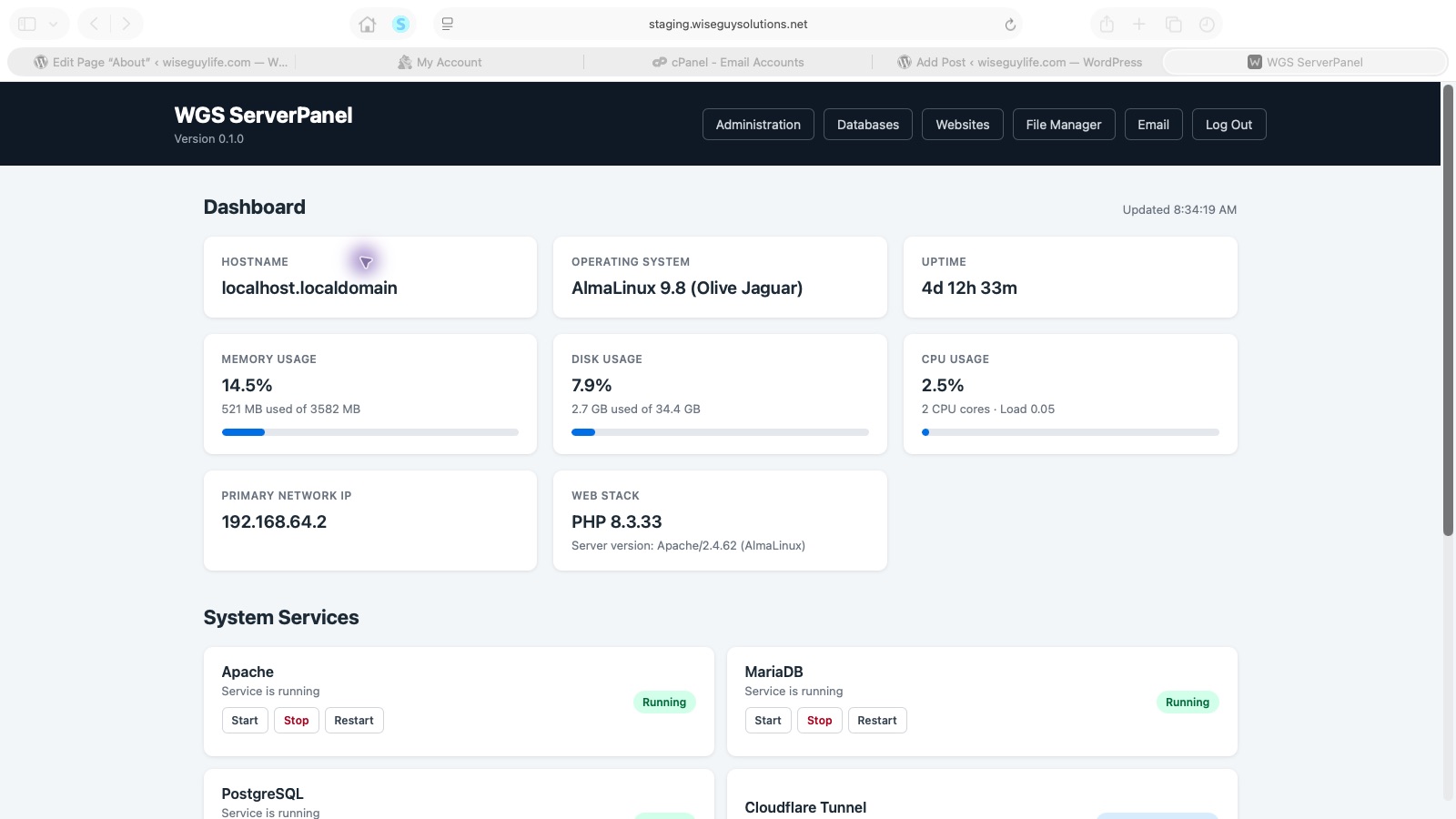
The panel has since grown to include sections for administration, databases, websites, file management, and email. WordPress management is part of the website tools. The aim is to bring routine tasks into a browser interface that fits how I work.
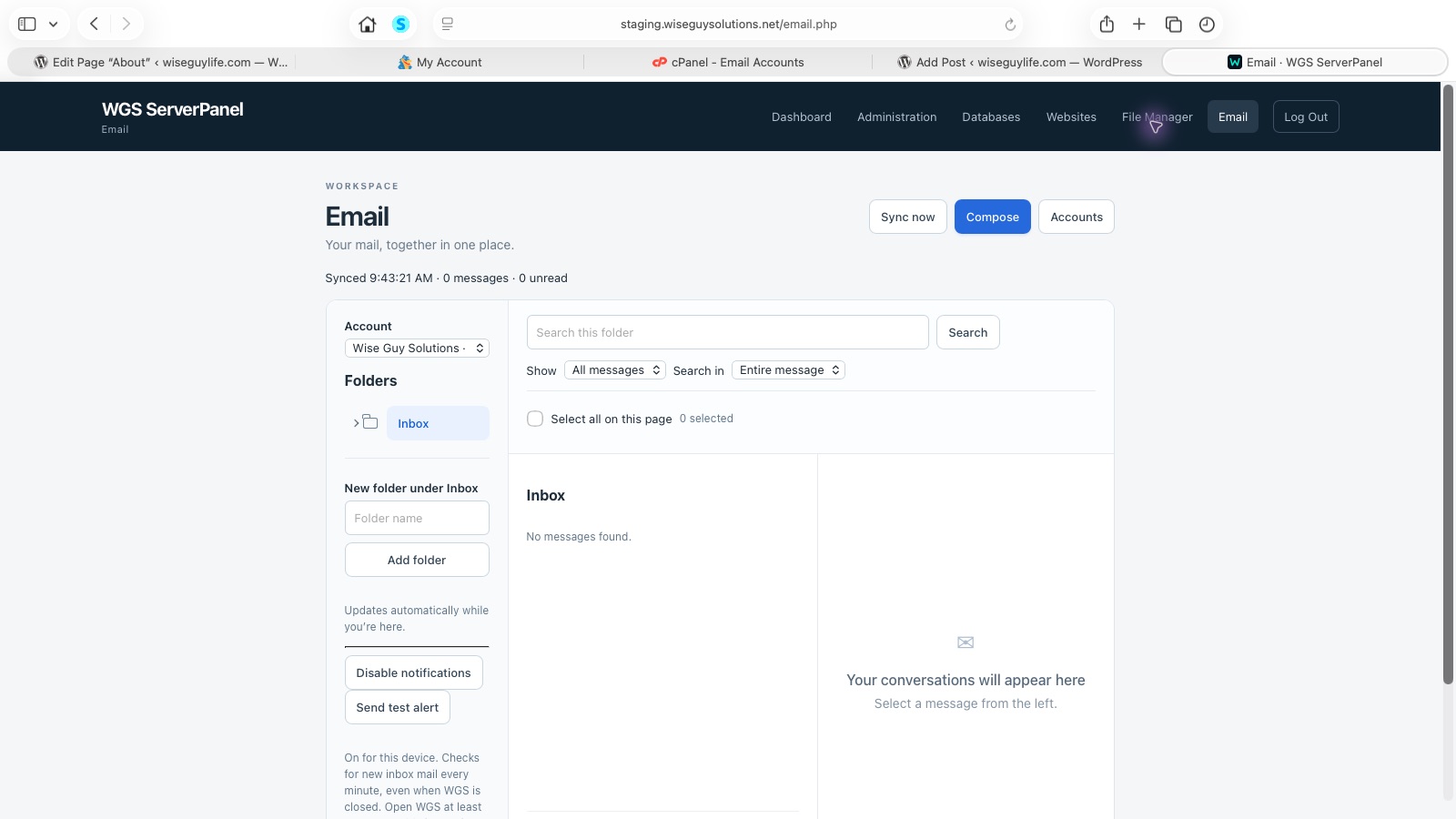
We’ve also worked on the less visible pieces: authentication, access roles, request checks, and the separation between the interface and the backend that carries out operations. The email work includes a browser workspace with folders, search, and message composition. I’ve seen that workspace running in staging; it remains part of an evolving project.
Building the interface is only one part of the job. Testing, reviewing changes, and separating staging work from production are part of making these tools dependable. A feature appearing on screen does not mean every failure case has been resolved.
How long has this taken?
September 15: first confirmed powered-on server setup message.
September 16: early WGS ServerPanel dashboard and backend work.
September 17: WordPress management and custom theme work in our conversations.
September 22: recorded panel architecture review and email implementation review.
September 27: website refinements and this progress update.
That is roughly 12 elapsed days—about 288 calendar hours from the initial setup date to this update. Those are not 288 working hours. The conversations record when we exchanged messages, but they do not measure every minute spent working, waiting, sleeping, or stepping away. I don’t have a reliable total of hands-on hours, so I won’t present one as a fact.
What AI has helped me do
This has been a back-and-forth process. I bring the direction, the questions, and my experience. AI helps draft code, explain unfamiliar details, troubleshoot problems, and review changes. I still have to decide what makes sense, check the results, and take responsibility for what goes live.
What encourages me is seeing those conversations turn into things I can use: a working environment, a personal publishing site, and a management panel that continues to grow.
The next challenge is deciding which useful application or service should come from this foundation. For today, I’m grateful to have something tangible to build on—and a place to share the process.